
Sora 2 Shutting Down: The Best Sora Alternatives I’m Actually Using Now.
If you're like me, you probably spent the last few months finally figuring out how to prompt Sora perfectly. And just when it clicks? The rug gets pulled.
But let me be direct about this: the end of Sora isn't the end of AI video. It's actually the beginning of a much better, less monopolized era. Over the past weekend, I tested the six strongest alternative video models on the market.
I'm going to show you exactly how they stack up against Sora, where these Sora Alternatives win, where they fail, and how you can access all of them without juggling six different subscriptions or credit card deposits, using Nano Banana ai.
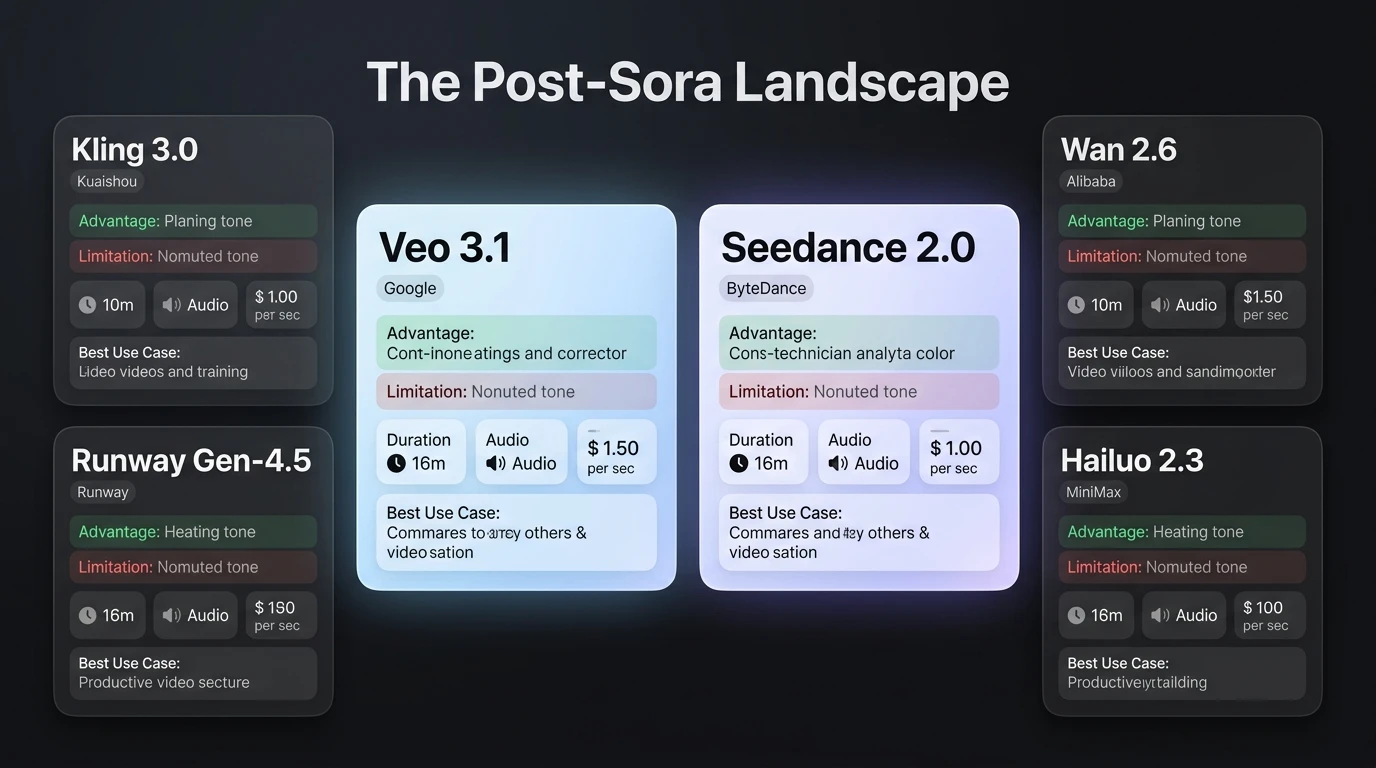
The Post-Sora Landscape
Here's a structured look at how these models compare to what we used to get from Sora.
| Model | Company | Advantage vs Sora | Disadvantage vs Sora | Max Duration | Audio Sync | Price/sec | Best Use Case |
|---|---|---|---|---|---|---|---|
| Veo 3.1 | Better physics and structural consistency | Less cinematic default styling | 60s | Yes (Pro) | $0.05 | Realistic physics simulations | |
| Kling 3.0 | Kuaishou | Insane prompt adherence, better human faces | Struggles with fast camera movements | 180s | Yes | $0.04 | Character narration and expressions |
| Seedance 2.0 | ByteDance | Incredible dynamic motion and action | Resolution drop on long pans | 60s | Partial | $0.03 | High-action sequences |
| Wan 2.6 | Alibaba | Photorealistic environments, hyper-detailed | Weak on complex multi-character scenes | 90s | No | $0.02 | Cinematic B-roll and landscapes |
| Runway Gen-4.5 | Runway | Superior camera controls (pan, tilt, zoom) | Less creative flexibility on weird prompts | 30s | Yes (Lip Sync) | $0.08 | Controlled film production |
| Hailuo 2.3 | MiniMax | Anime and stylized aesthetics | Lack of hyper-realism | 60s | Prompt-based | $0.03 | Animation and stylized storytelling |
The Model Breakdown
Let's dive into exactly what these models feel like to use in production.
Veo 3.1 (Google) Google's Veo 3.1 is the closest direct competitor in terms of raw physics understanding. Where Sora often hallucinates objects passing through each other, Veo actually understands solid mass and collision. The trade-off? The default aesthetic isn't as instantly cinematic as Sora. You have to prompt heavily for lighting and lens types. If you need realistic structural consistency, this is my go-to choice.
Kling 3.0 (Kuaishou) Kling 3.0 has completely revolutionized how we generate human faces. While Sora always struggled with maintaining facial consistency across a shot, Kling holds the features tight. Its prompt adherence is arguably the best on the market right now. However, it does struggle when you ask for fast, whipping camera movements. It's the absolute best model right now for tight character shots and emotional expressions.
Seedance 2.0 (ByteDance) If you want to create a high-speed car chase, you use Seedance 2.0. ByteDance built this model specifically for dynamic motion, and it outpaces Sora in rendering fast-moving objects without tearing. The honest downside is that when you attempt long, slow camera pans, the resolution sometimes subtly degrades. It's the undeniable winner for high-action sequences and music videos.
Wan 2.6 (Alibaba) Alibaba's Wan 2.6 is the secret weapon for environmental design. If you need hyper-detailed, photorealistic landscapes or interior shots, Wan beats Sora's texture fidelity easily. It understands lighting bounce and reflections at a stunning level. It's not perfect, though—if you try to prompt complex interactions between multiple characters, it gets confused fast. But for cinematic B-roll and architectural visualization, there is nothing better.
Runway Gen-4.5 (Runway) Runway Gen-4.5 remains the director's tool. Sora was a black box—you typed a prompt and hoped for the best. Runway actually gives you precise slider controls for camera movement. It fits seamlessly into a traditional film workflow. The limitation is that it's less imaginatively flexible compared to Sora's weird imagination. It's built for controlled, professional film production.
Hailuo 2.3 (MiniMax) MiniMax's Hailuo 2.3 occupies a very specific, highly lucrative niche. It has completely mastered stylized aesthetics and anime-style generation. While Sora leaned heavily toward live-action realism, Hailuo understands 2D and 3D animation prompts flawlessly. Its main disadvantage is that it can't produce hyper-realism. But if you are building an animated series or stylized project, Hailuo is unmatched.
The Aggregator Problem
Here's the reality of the Post-Sora world. We have six incredible models, each with distinct superpowers.
But using them practically is a nightmare. You have to register six different accounts. You have to fund six different prepaid wallets. You have to constantly switch tabs between six different UI dashboards, each with their own learning curve.
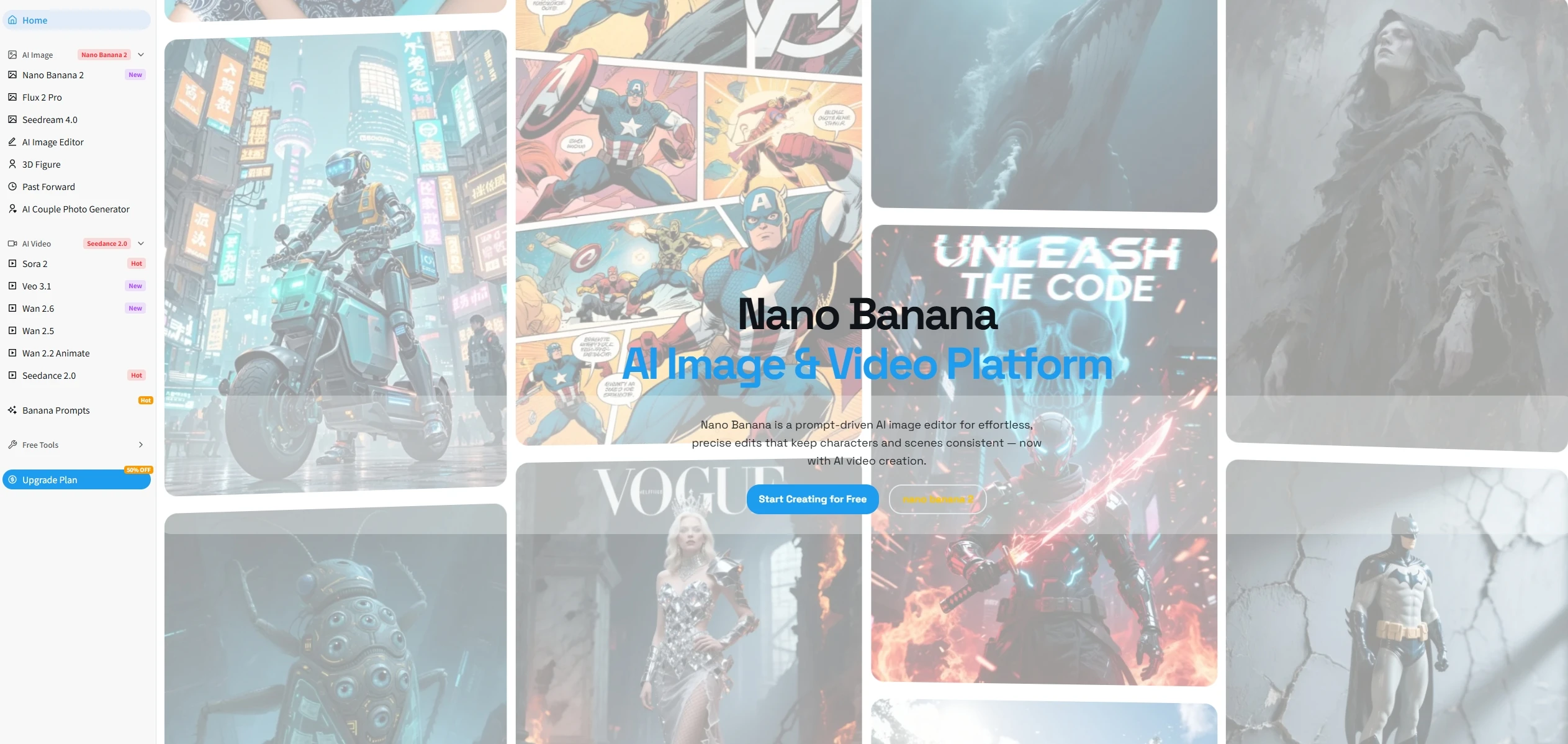
This is exactly why I stopped using native apps and moved my entire workflow to Nano banana. It's a unified platform that gives you one single account to access all six of these models. You use one unified prompt interface, pay from one single wallet, and the billing is purely pay-as-you-go per second. It's cheaper, completely frictionless, and lets you route the right prompt to the right model instantly.
The Beginning of the Post-Sora Era
The Sora era is officially over. But honestly? The Post-Sora era is already looking much more powerful, diverse, and accessible. You don't need to choose just one model, and you definitely don't need to juggle six subscriptions.
Stop wasting time managing accounts. Go to Nano banana ai image & Video Platform right now to try all 6 of these models for free. No multiple accounts, no separate top-ups. Just pure building.